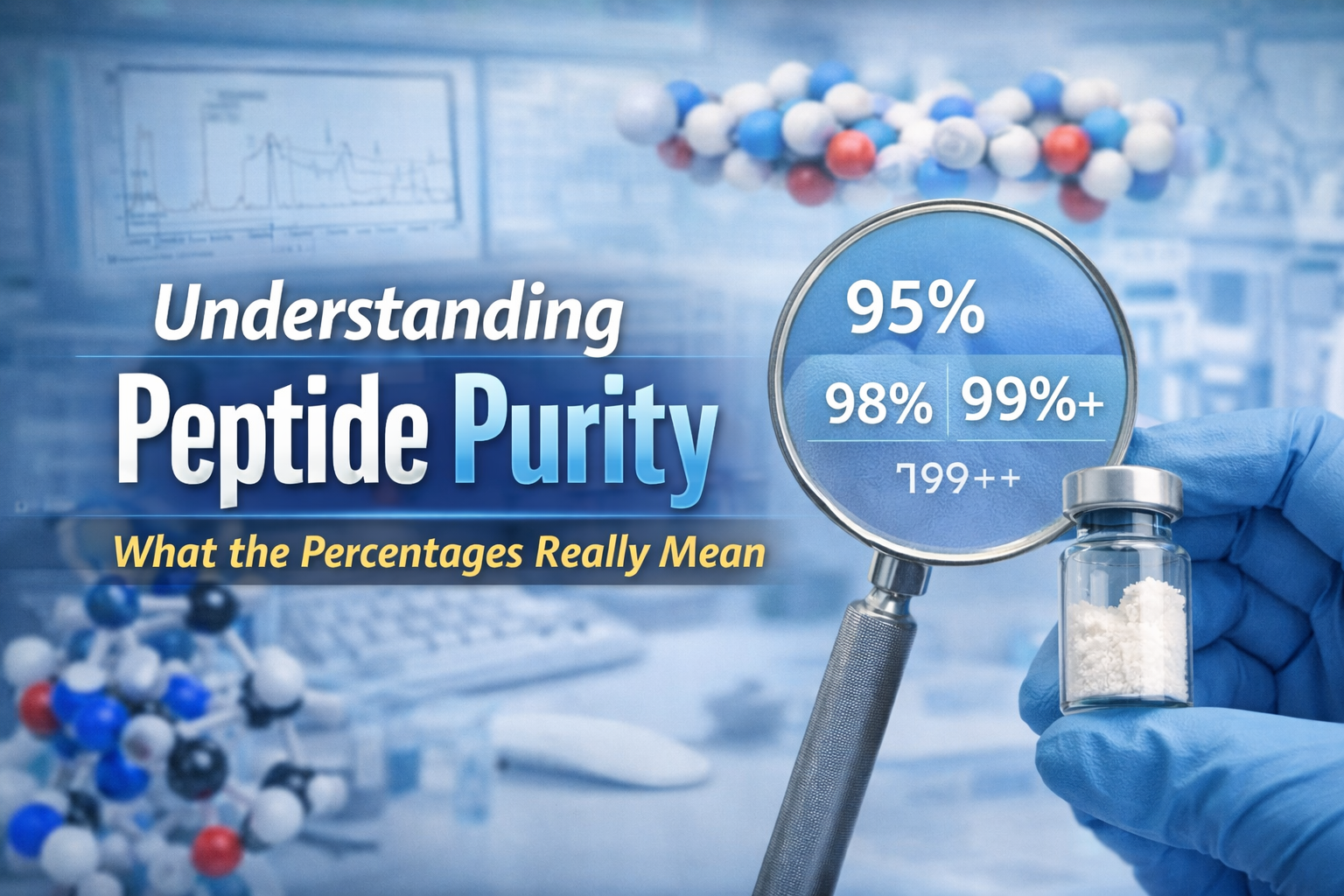
Recognizing Peptide Pureness: What 99%+ Actually Means
Peptide Pureness Analysis Service
Peak Lab is a customized distributor of high-purity chemical reagents and peptides. All items provided are strictly for in-vitro research laboratory research and development utilize only. Discover flagship research peptides with batch-specific COA documentation and HPLC/MS confirmation. Products are for in-vitro lab research use only and are except human intake.If you've ever searched a peptide brochure, you've seen pureness numbers everywhere. These numbers obtain thrown around so commonly that it's very easy to gloss over them-- simply one more spec on a product page. Chameleon Peptides markets study compounds specifically for research laboratory and logical purposes. All PRG products are planned solely for artificial insemination research or more manufacturing usage. Making use of a highly detoxified peptide minimizes these dangers and enhances the dependability of your information.
Trustworthy peptide suppliers always note their items this way and provide high quality reports with HPLC and MS information to support the pureness level. As long as you get peptides from a relied on resource that offers a full certification of evaluation, you can be confident in the peptide's purity quality and use extent. Peptides are evaluated through a mix of techniques, including HPLC for pureness, mass spectrometry (MS) for sequence verification, and nuclear magnetic resonance (NMR) for architectural evaluation. These methods aid determine the peptide's structure, verify the molecular weight, and spot any architectural alterations or pollutants, making certain the peptide meets quality and spec requirements. With our comprehensive peptide analysis platform, Innovative Proteomics has established an extremely sensitive and specific platform.Nanoparticle Physicochemical Residential Property Evaluation
What Hplc Can Not Prove Alone
The buddy page on why 99 percent purity issues explains why tiny pollutant percentages can still matter in sensitive in-vitro assays. Together with this peptide screening guide, those web pages create the trust-methodology layer behind the product catalog. Peptide testing is effective, yet scientists ought to review the extent of each method very carefully.
A functional assay gauging downstream signaling-- or an architectural research study using NMR or X-ray crystallography-- requires the highest purity available. Crystallographers in particular commonly need ≥ 98% purity because even minor pollutants can avoid crystal formation or present condition right into the crystal lattice. As particles leave the column, they go through a detector-- generally a UV detector readied to 214 or 220 nm, wavelengths where the peptide bond absorbs light highly. The detector documents how much UV light is absorbed in time, generating a chart called a chromatogram. This overview breaks down what pureness really implies in peptide chemistry, how it's gauged, what the contaminations are, and how to read the documents that proves a peptide is what it claims to be.
The software draws boundaries around each peak and calculates the area below. The purity portion originates from comparing the location of the major height to the total location of all detected peaks. Most reports include a table listing each top's retention time, area, and portion of overall area.- Alternatively, making use of peptides that have actually passed third-party laboratory validation helps make sure that the observed speculative effects are absolutely due to the intended peptide and not because of impurities or mistakes.
- These numbers get thrown around so often that it's very easy to gloss over them-- just an additional specification on an item page.
- HPLC-tested means the sample was gone through high-performance liquid chromatography to divide the target peptide from impurities.
- As the percent of natural solvent gradually boosts throughout the run, molecules are launched from the column in order of their hydrophobicity-- the much more hydrophobic a peptide, the longer it requires to elute (clean off).